Why Are Baking Materials Important for Global Buyers?
For global buyers, baking materials are more than flour, fats, leaveners, and packaging. They shape product consistency, shelf life, production efficiency, and the reliability of supply. A bakery may depend on flour from one region, cocoa from another, and food-contact packaging from a third. Each input brings different specifications, lead times, and handling needs. Small changes matter. A flour’s protein level can affect dough performance, while a packaging barrier can influence how quickly a baked product loses freshness.
Industry data shows why careful sourcing deserves attention. FAO’s The State of Food Security and Nutrition in the World 2023 estimated that 13.2% of food was lost between harvest and retail in 2021. UNEP’s Food Waste Index Report 2024 estimated that 1.05 billion tonnes of food were wasted in 2022 across households, food service, and retail. These figures cover food systems broadly, not baking alone. Still, they underline the value of sound storage, suitable packaging, and dependable ingredient specifications. Materials cannot solve every supply-chain problem. That point is easy to overlook.
For buyers, the task is to assess more than price. Compare technical documentation, batch consistency, transport conditions, and supplier communication. A low-cost ingredient may require extra testing or create avoidable production variation. A reliable decision starts with evidence—and with questions that remain open when the evidence is incomplete.
What Baking Materials Include and How They Are Used
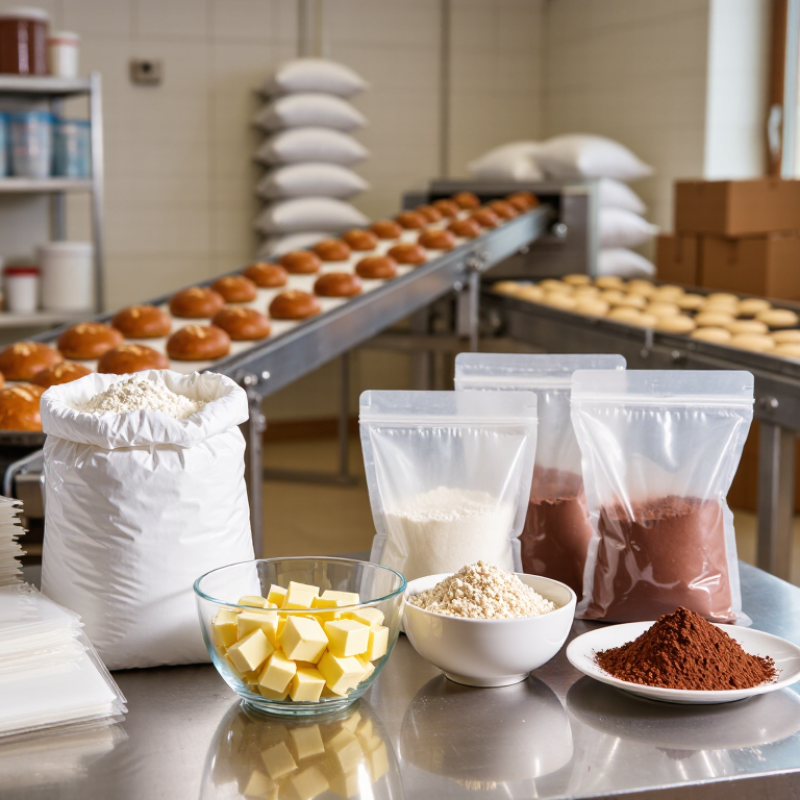
Baking materials include core ingredients, specialty inclusions, and supplies that contact dough or batter. Flour builds structure, while yeast or baking powder creates lift. Fats influence tenderness and mouthfeel; sugar adds sweetness, color, and moisture. Eggs can bind ingredients and help a cake set. Cocoa, dried fruit, seeds, and nuts bring distinct flavors and textures. Small details matter. A flour’s protein level can change how much water dough absorbs, so buyers should compare technical specifications rather than relying on product names alone.
Materials also include parchment, baking cups, and food-contact liners used during production. Their heat resistance and fit can affect release, appearance, and waste. Global buyers often review ingredient composition, moisture limits, allergen information, pack size, and storage guidance before placing orders. Dry powders need sealed packaging and protection from humidity; some fats or fillings may need controlled storage. Keep batches consistent. Trial samples can reveal how an ingredient behaves in a real recipe, though one test may not reflect every production line. Specifications help, but they cannot predict every oven or local preference.
Key Properties That Affect Baking Performance
Baking materials influence how evenly heat reaches a dough, how quickly its surface browns, and whether it releases cleanly.
The ASM Handbook reports thermal conductivity around 120–230 W/m·K for many aluminum alloys, compared with roughly 14–16 W/m·K for austenitic stainless steel. That gap matters. Thin aluminum sheets respond quickly, while thicker steel pans may heat more slowly and retain heat differently. Actual results still depend on alloy, thickness, finish, oven airflow, and where the pan sits. A conductivity figure alone is not a buying verdict.
Moisture and grease resistance also affect performance. ASTM E96/E96M provides a standard method for measuring water-vapor transmission through materials; buyers can use test results to compare liners and packaging under stated conditions. Check the test temperature and humidity, since a number without its conditions is easy to misread. For trays, inspect flatness and coating durability: a warped sheet can brown cookies unevenly, and a damaged release surface may leave stubborn patches. Small details. One caution: “nonstick” does not guarantee the same release after repeated heating and washing. I would compare documented test conditions with the intended oven use, then trial a small batch. Real kitchens are less tidy than specifications.
Food Safety and Regulatory Requirements Across Markets
Why Are Baking Materials Important for Global Buyers?
Food Safety and Regulatory Requirements Across Markets
Baking materials touch food during mixing, baking, cooling, or storage. Their safety matters as much as their performance. A tray liner may face direct heat, while a cake box usually contacts food after baking. Buyers should match each material to its actual use. Small details matter. Check whether coatings, inks, adhesives, or recycled content are suitable for the intended contact and temperature. Ask suppliers for current food-contact declarations and relevant test reports. Confirm that documents cover the exact material and use conditions.
Rules differ across markets, and requirements can change. A document accepted in one destination may not satisfy another. Importers should check local requirements for composition, migration limits, labeling, and language before shipping. Keep batch records, supplier details, and test documents together. This makes questions easier to resolve if a shipment is inspected or a material changes. Still, paperwork is not proof of perfect control. A report can be outdated or describe a different thickness. That gap is easy to miss.
Tips: Record each material’s intended use, contact time, and temperature. Recheck documents when suppliers or specifications change. When details are unclear, pause and seek qualified local guidance.
How Sourcing Choices Shape Cost and Supply Reliability
For global buyers, baking materials are not interchangeable line items. Flour, sugar, oils, cocoa, and leavening agents each affect yield, texture, and production speed. A lower quoted price can disappear when freight, customs handling, or damaged packaging adds cost. Flour with uneven moisture, for example, may require recipe adjustments and slow a production run. Small details matter. Buyers can compare technical specifications, request samples, and check whether suppliers can maintain consistent quality across repeat orders. These checks take time, and they do not remove every risk.
Sourcing geography changes both landed cost and delivery reliability. Ocean freight may look economical, but port delays can disrupt production schedules. Qualifying a second source and setting practical safety-stock levels can reduce exposure to interruptions. That approach ties up cash, though, and poor storage conditions can weaken some ingredients. There is no perfect buffer. Reviewing order history, lead times, and seasonal demand helps teams decide when to buy and how much to hold. Forecasts still miss things; a crop shortage or sudden freight increase can overturn a tidy spreadsheet. A useful measure is not unit price alone, but the cost of consistent batches and on-time orders.
Why Material Consistency Matters to Global Buyers
For global buyers, material consistency is a production control, not a cosmetic preference. Flour with shifting moisture levels can change dough absorption; baking paper with uneven thickness may brown or release differently across trays. Small shifts matter. They can mean extra test batches, altered bake times, or rejected goods at a distant facility. Buyers should compare measurable specifications, such as moisture, particle size, thickness, and heat resistance, rather than relying on a sample that performed well once.
Supply chains make that discipline harder. McKinsey’s 2020 survey of supply-chain leaders found that 93% planned to increase resilience. Consistent materials support that goal by making substitutions and production planning more predictable. ISO’s 2022 Survey recorded more than 1.26 million ISO 9001 certificates across 189 countries, showing how widely quality-management systems are used. Still, certification is not proof that every batch behaves identically. Ask suppliers for batch-level test records, tolerances, and notice of specification changes.
A practical incoming check can catch problems early: measure a delivered material, compare its certificate of analysis with the agreed limits, and run a small oven trial. Record the temperature, bake time, and result. That is not enough. Local humidity, storage, and equipment can also change performance, so buyers should validate materials under their own conditions. I would not assume a stable specification guarantees a stable bake; it gives teams a clearer place to investigate when results drift.