Top QR Code Packaging Bag Suppliers in China?
Choosing a reliable supplier for a Qr Code Packaging Bag involves more than comparing prices. Buyers should check print clarity, material consistency, sealing strength, and the supplier’s ability to keep codes readable across production runs. A code that looks sharp on a screen may blur on a glossy pouch. Small details matter.
China offers a broad supplier base, from flexible-packaging manufacturers to custom-printing specialists. This guide explains how to assess their capabilities, request useful samples, and compare quotes without overlooking production details. Ask for a sample printed on the intended material. Scan it under ordinary lighting, then test it after folding and handling. A quick scan is not enough.
Trust begins with evidence. Review factory information, request relevant quality records, and confirm who handles artwork checks and pre-production approval. Be specific about dimensions, film structure, finish, and expected order quantities. Vague specifications can lead to costly revisions. They often do.
An industry expert’s name and verified quotation were not included in the source material, so this introduction does not invent one. That matters: expert attribution should be checked before publication, not added for decoration. The sections ahead offer a practical framework for identifying suppliers that can deliver consistent bags and dependable QR-code readability. A careful comparison can save time, reduce avoidable reprints, and make the final packaging easier for customers to use.
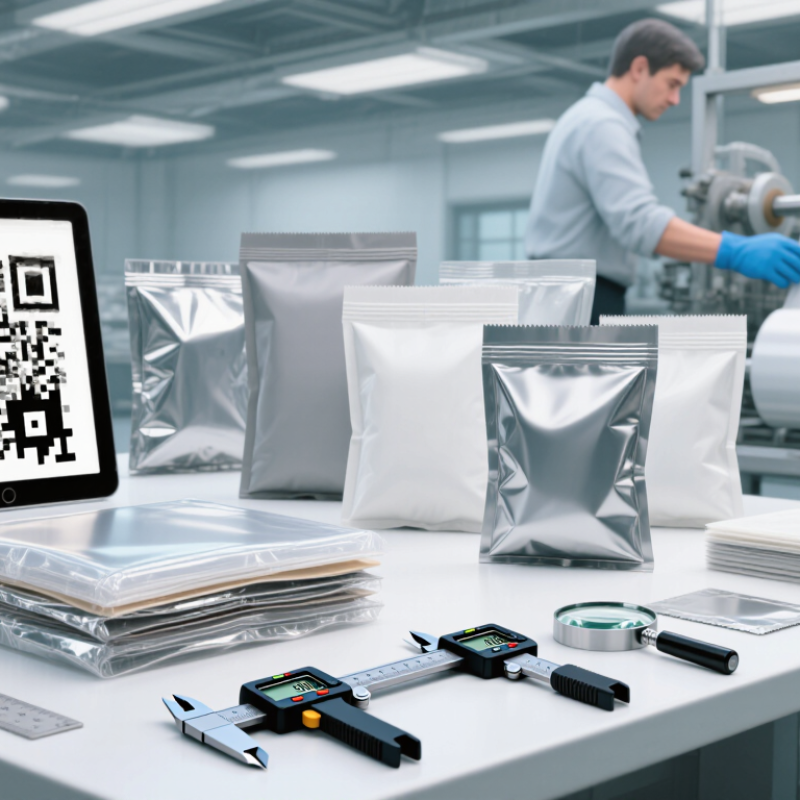
QR-Code Bag Basics: ISO/IEC 18004 and Up to 7,089 Numeric Characters
QR-code bag basics start with the standard behind the symbol. ISO/IEC 18004 specifies QR Code structure, encoding, and error correction. Under ideal conditions, a Version 40 symbol at the lowest error-correction level can hold up to 7,089 numeric characters. That figure is a technical maximum, not a packaging target. A dense code needs more space and may be harder to scan on a curved, glossy, or creased bag. Small codes fail.
Tips: Keep the code high-contrast, preserve its clear border, and test it on the actual bag material. Try several phones and scan angles. A proof on a flat screen is not enough.
When evaluating bag suppliers, ask for printed samples and confirm how they control registration, ink spread, and surface finish. These details affect whether the code remains readable after filling and handling. Use a short URL or compact product data when possible; fewer characters can produce a simpler, more resilient symbol. There is a trade-off: stronger error correction can help with minor damage, but it also increases code density. Specifications alone cannot guarantee reliable scanning, and overlooking that is an easy mistake.
QR Code Numeric Capacity by Version
Under ISO/IEC 18004, QR Code capacity depends on the symbol version, error-correction level, and data mode. At error-correction level L, Version 40 can encode up to 7,089 numeric characters. Packaging designs should be tested for reliable scanning at their final printed size.
Bag Structures: Compare PE, PET/PE, and PET/Aluminum/PE Laminates
For buyers comparing QR code packaging bag suppliers in China, laminate choice affects print quality, barrier performance, and filling-line behavior. The Flexible Packaging Association’s 2024 State of the Industry report valued U.S. flexible packaging sales at $42.9 billion in 2023, underscoring the scale of this packaging format. That figure is not a China-specific benchmark, but it highlights why material specifications deserve careful review.
PE bags are flexible and can provide useful moisture protection, but they generally offer less oxygen and aroma protection than foil-based structures. PET/PE combines a printable, dimensionally stable outer layer with a heat-sealable inner layer. It suits many dry products, though the exact barrier depends on film grades and thickness. PET/Aluminum/PE provides stronger protection from light, oxygen, and moisture. The trade-off is important: mixed layers can be harder to recycle in many existing systems. Not always simple.
For QR codes, specify a visible print surface, high contrast, and resistance to rubbing. On PET/Aluminum/PE, print the code on the exterior; aluminum blocks scanning through the laminate. Ask suppliers for layer thicknesses, barrier test results, and samples made on the intended production line. Test the code after filling, sealing, and handling. A sample that scans on a desk may fail after condensation or abrasion. Small detail, big difference.
Top QR Code Packaging Bag Suppliers in China? — Bag Structures: Compare PE, PET/PE, and PET/Aluminum/PE Laminates
| Bag Structure | Typical Construction | Barrier Performance | Print Surface and QR Code Use | Common Applications | Key Considerations |
| PE | One or more polyethylene layers; may use different PE grades or processing methods. | Provides moisture resistance. Protection against oxygen, light, and aroma depends on the grade, thickness, and bag design; it is generally lower than a foil laminate. | Can be printed, but the surface may need treatment or a suitable ink system for good ink adhesion. Keep the QR code on a smooth, uncreased area with strong contrast. | Products with moderate barrier needs, refill packs, and applications prioritizing a flexible PE-based structure. | PE-based packaging may be compatible with some PE recycling streams, but acceptance depends on the complete pack, local collection and sorting systems, and applicable design guidelines. |
| PET/PE | Printed polyester (PET) outer layer laminated to a polyethylene (PE) sealant layer. | Typically offers better oxygen and aroma protection than a simple PE structure; actual performance varies with film grade, thickness, and laminate construction. | PET commonly provides a stable outer printing surface. A QR code can be printed on the outside or incorporated into the print design; confirm readability on the finished bag. | Snack foods, dry goods, and other products needing a printable outer layer and a heat-sealable inner layer. | The PET and PE layers are different polymers, so the laminate is not generally compatible with standard PE-only recycling streams. Check local recycling guidance. |
| PET/Aluminum/PE | Printed PET outer layer, aluminum foil barrier layer, and PE heat-seal layer. | Very high barrier to moisture, oxygen, light, and aroma when the laminate is properly designed and sealed. | PET provides an outer print surface, while the foil layer blocks light. Place the QR code in a clear, high-contrast printed area and avoid folds, gussets, seals, and heavily curved zones. | Light-, oxygen-, or moisture-sensitive products, including products requiring extended protection from environmental exposure. | Offers strong protection but uses multiple materials and is generally difficult to recycle through common flexible-plastic collection streams. Foil laminate is not microwave-safe unless specifically designed and labeled for that use. |
QR code check: Readability depends on code size, contrast, print quality, surface finish, bag curvature, folds, and the scanning device. Test codes on production-equivalent bags under expected lighting and handling conditions. Barrier performance and recyclability should be confirmed for the specific material specification and local market.
Supplier Compliance: Check GB 4806.7-2023 and ISO 9001 Certification
When comparing QR code packaging bag suppliers in China, check whether the bag is intended to contact food. For plastic food-contact bags, ask for evidence against GB 4806.7-2023, China’s food safety standard for plastic materials and articles. Details matter. A report should match the actual resin, layers, thickness, and intended use—not just a similar sample.
Request recent test reports and review the migration test conditions, sample description, and issuing laboratory. If the QR code is printed on the outer surface, ask how inks and adhesives are controlled, especially where layers may touch food. A tidy PDF can still leave questions: does it cover the bag you plan to order? That check is easy to overlook.
ISO 9001 certification can indicate a documented quality management system, but it is not proof that a specific bag meets food-contact requirements. Check the certificate’s validity, certified company name, and scope. Ask how the supplier controls incoming film, printing, sealing, and batch records. A brief factory discussion can reveal whether these checks happen consistently. Paperwork helps, but real production details deserve a second look.
QR Print Verification: Assess Error-Correction Levels L, M, Q, and H
When comparing Chinese QR-code packaging-bag suppliers, ask for verification results from printed samples, not just artwork proofs. ISO/IEC 18004 specifies approximate QR Code error-correction capacities: Level L restores about 7% of codewords, M 15%, Q 25%, and H 30%. These figures describe recoverable codewords, not the share of a damaged label guaranteed to scan. Higher correction can help when ink is scuffed or a bag creases, but it may require a larger symbol. Small print changes everything.
Match the level to the actual packaging conditions. A clean, high-contrast bag may work well at M; rough handling or variable print quality can justify testing Q or H. Yet stronger correction cannot rescue a blurred symbol, weak contrast, or missing quiet zone. ISO/IEC 15415 provides a grading method for assessing printed two-dimensional symbol quality. Ask suppliers for verifier readings on production material, including samples taken from different positions across the run. Check the final bag under ordinary phone cameras and realistic lighting, too. That practical test is easy to overlook. A slightly awkward truth: no single correction level compensates for inconsistent printing. Use the standards as evidence, then confirm performance on the finished bag.